
Prototype eight: the grip test
What the grip test is
The grip test is the test we made up to decide whether a prototype is good enough to keep developing. It is simple: put the prototype on a leather sofa, sit on the same cushion, watch a two-hour movie, and see if the prototype is still in the same position at the end.
Most prototypes fail. They slide when the cushion shifts, tip when a heavy cup is placed off-center, or settle into a position where the cup well is no longer level. All three count as a fail.
What the first seven prototypes failed at
- Prototype 1: silicone too soft. Cup sank into the well. Failed within ten minutes.
- Prototype 2: silicone too thin. Walls flexed under the cup. Cup tipped at hour one.
- Prototype 3: wrong shape. Cup well too narrow for a real drink. Drink fell out when reaching for the remote.
- Prototype 4: too light. Slid off the armrest when the cushion shifted.
- Prototype 5: too heavy. Started to deform the armrest cushion. Looked permanent in a bad way.
- Prototype 6: right weight, wrong base. Bottom surface was too textured. Caught on the leather and slid.
- Prototype 7: right base, wrong well. Cup well was deep enough but too wide. Cup rattled at every shift.
What changed in prototype eight
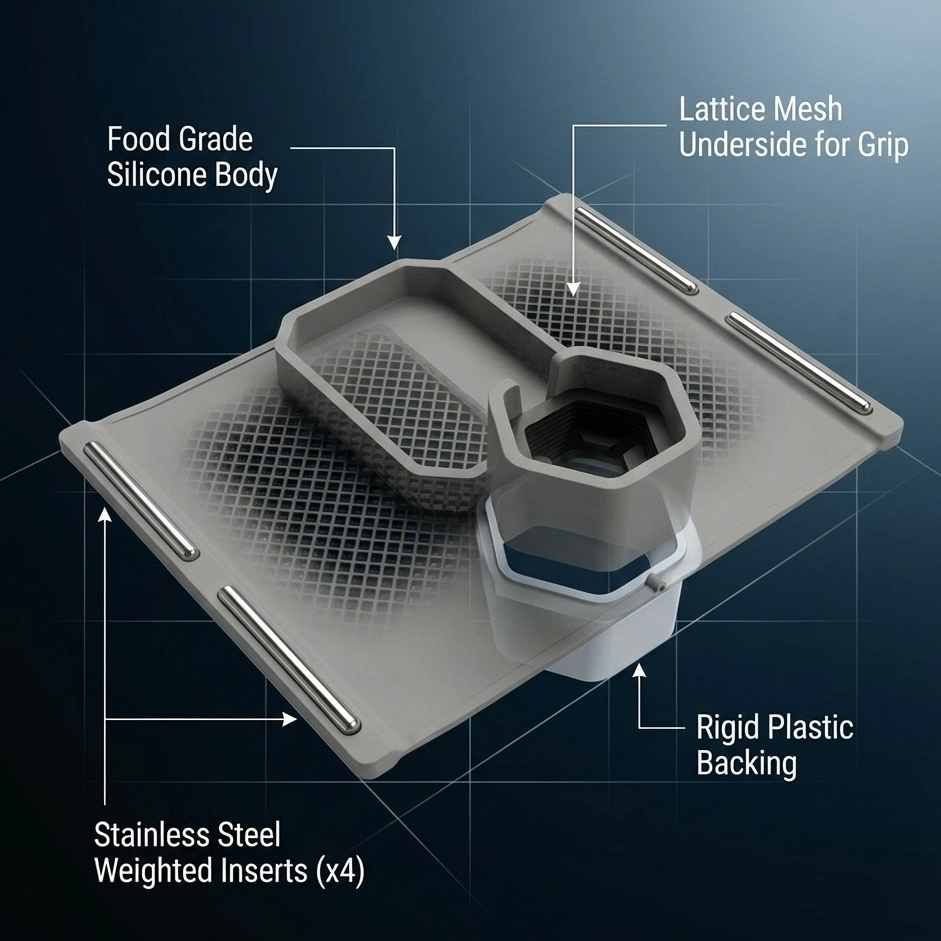
Prototype eight took the base from prototype six, the weight from prototype four (rebalanced), the well depth from prototype five (resized), and the silicone formulation from prototype two (firmed up by 10 points on the Shore A scale).
We sat through three movies and a sports game with it. Cup did not move. Tray did not slide. Cushion did not deform. The prototype was still in the same position at the end of every test session.
What is still wrong
Prototype eight is the right design. It is not yet the right product. The remaining problems:
- Cost. Heavy silicone is expensive. The tooling has to amortize across at least 10,000 units to make sense.
- Color. The off-the-shelf grey is not quite right. It looks slightly green in daylight.
- Packaging. A 14-ounce silicone object in a poly bag pushes us into a worse FBA shipping bracket. We need a box.
- Branding. The brand has no logo, no listing copy worth using, and no presence on any platform.
Timeline from here
All four of those problems are solvable, but each takes months. The cost issue means a real conversation with a real factory, which means a real purchase order, which means a real bank balance. We have neither yet.
The earliest we can ship the prototype-eight version is mid-2022. That feels far away. It is also the right speed for the product. Better the right version slowly than the wrong version fast.
Frequently asked questions
How many prototypes did the Sofa Sidekick go through in total?
About fifteen prototypes from 2017 through 2022. Prototype eight was the first version that passed the grip test. Prototypes 9 through 15 were refinements of the same basic design.
Why is silicone formulation so important?
Small changes in silicone formulation, especially the durometer and the filler content, change how the material behaves at room temperature. A change of 10 points on the Shore A scale is the difference between ‘cup sinks into the well’ and ‘cup stays level.’
What is the FBA dim-weight bracket issue?
Amazon’s FBA shipping costs are based on both weight and box dimensions, with thresholds that change the cost bracket. A poly bag for a 14-ounce silicone object pushed us into a higher bracket because the bag was the wrong shape. A flat box solved it.