
Why silicone grips leather (and what doesn't)
Why most things slide on leather
Leather is a smooth, slightly waxy surface. It is designed to wipe clean, which means liquids and solid objects both have very little to grip. The coefficient of friction between most plastics and leather is low enough that any incline or vibration moves the object.
Wood does slightly better because the grain creates micro-scale roughness, but solid wood on leather will still slide if the leather is conditioned or if the wood is finished too smoothly. Fabric helps but introduces the spill-absorption problem.
What makes silicone different
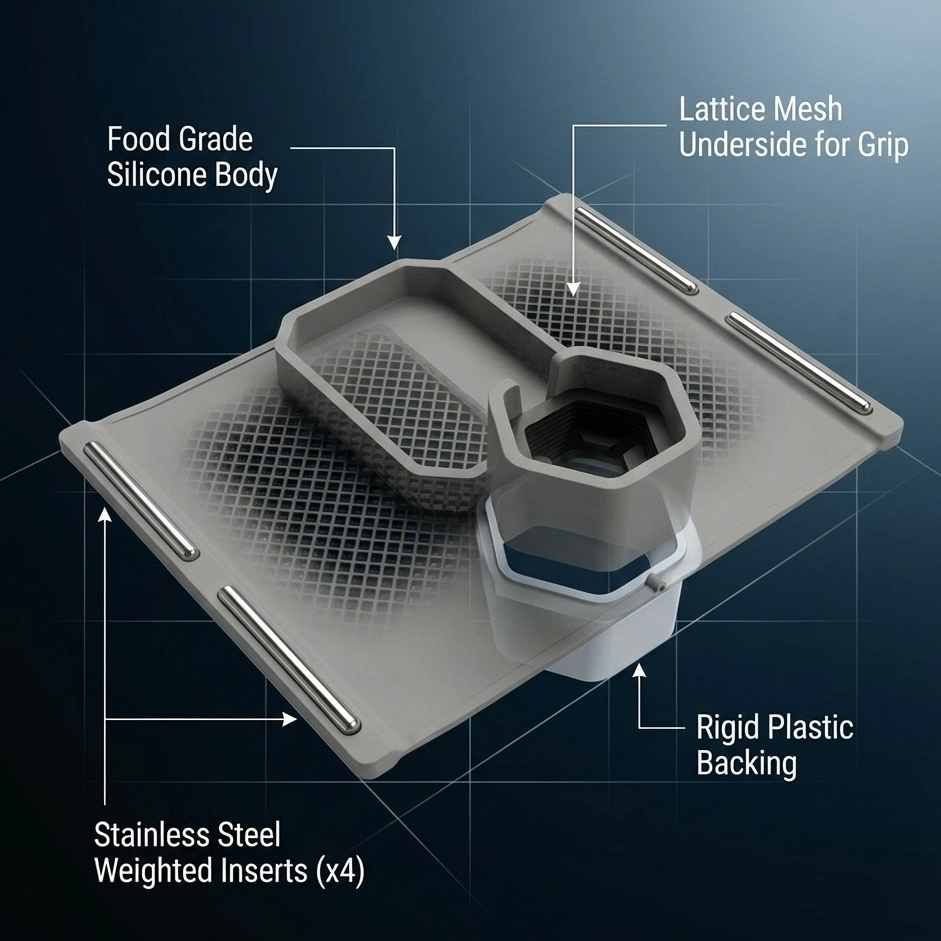
Silicone has two properties that other materials do not have together. It is slightly soft, which means it deforms at the micro level to follow the texture of whatever it is sitting on. And it has a high coefficient of friction, which means even a small amount of weight on top creates enough resistance to stay in place.
Together, those two properties mean a heavy silicone object on a leather surface effectively bonds at the micro level. It does not slide. It also does not need a clamp or any other mechanical hold.
Why this matters for couch products
Most cup holders for couches use mechanical holds. Clamps, clips, brackets, weighted bases that fit only on flat surfaces. All of those have failure modes. The clamp scratches. The clip breaks. The bracket needs the right armrest geometry.
A heavy silicone tray has no failure mode of its own. It does not depend on the shape of the armrest. It does not need to clip onto anything. It works because the material works.
The three numbers that matter
- Durometer (firmness): Shore A 60 to 75 is the right range. Below 60 is too soft and deforms under a heavy cup. Above 75 is too firm and does not grip the armrest.
- Weight: 12 to 16 ounces. Heavy enough to stay put, light enough to move between rooms.
- Wall thickness: 4 to 6 millimeters. Thinner flexes too much. Thicker becomes wasteful and overpriced.
Why other materials lose
- Rubber: similar friction, but degrades faster, often smells, and can leave marks on light leather.
- Foam: high friction, but no structural rigidity. Cup falls through.
- Plastic: low friction, scratches leather, looks like a toy.
- Wood: moderate friction, holds a cup, scratches leather if dropped.
All of these are tradeoffs we made before settling on silicone. The material decision was final by the end of 2019. Everything since has been about shape, weight, and color.
Frequently asked questions
Will silicone leave a mark on leather?
No. Silicone is chemically inert and does not transfer color or oil to leather. It can leave a temporary indentation if left in one spot for months, which disappears within hours of removing the tray.
What is the difference between food-grade and industrial silicone?
Food-grade silicone is certified for direct food contact and meets FDA standards. Industrial silicone is not certified for food contact and may contain fillers that change color or off-gas. We use food-grade silicone for everything that might touch a drink or snack.
Will silicone get hot or cold?
Silicone has low thermal conductivity, which means it does not transfer heat or cold quickly. A silicone tray with an iced drink on top stays close to room temperature on the bottom side, which is why it does not chill the couch underneath.